Izwi Lakhe: A Quiet Bible App for Real People
Why I built a Zulu/English Bible app without streaks, plans, or notifications
The Name
Izwi Lakhe means "His Word" in isiZulu.
It comes from John 1:1 — "Ekuqaleni kwakukhona iZwi, iZwi lalikuNkulunkulu, iZwi lalinguNkulunkulu."
"In the beginning was the Word, and the Word was with God, and the Word was God."
The Word. Not noise. Not distraction. Not engagement metrics.
The Word.
That's what this app is about.
Why Zulu Matters (Cultural Representation)
This app is not just about reading. It's about cultural representation.
For generations, Zulu Christians have read the Bible in a language that was not their own — or in translations that felt foreign. The 1859 Zulu Bible changed that. It was the first time isiZulu speakers could read Scripture in their mother tongue, the language of their hearts.
But here's the problem: Most digital Bible apps don't treat Zulu as a first-class language.
You open a popular app. Zulu might be buried in a list of 2,000+ versions. The interface is still English. The navigation assumes digital fluency. The fonts don't support Zulu diacritics properly.
That's not representation. That's an afterthought.
Izwi Lakhe is different.
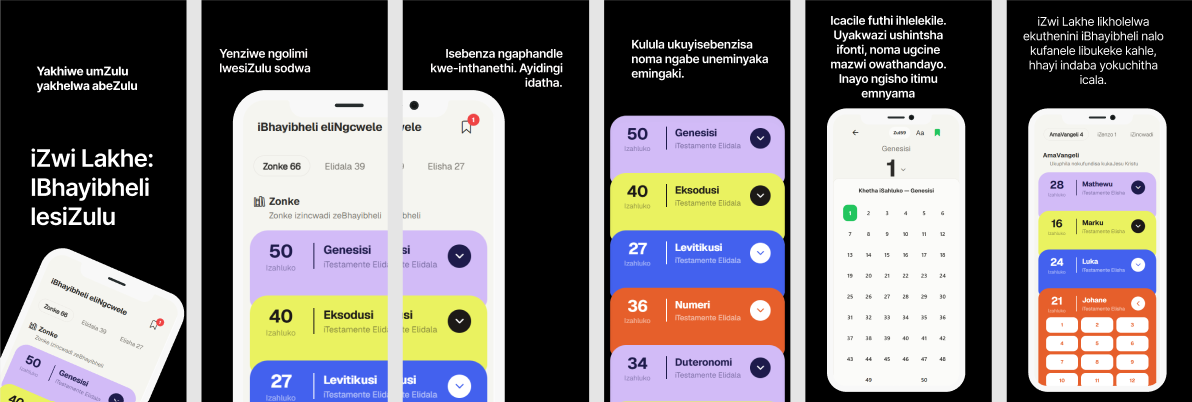
- The interface is in Zulu first
- The 1859 translation is front and center, not hidden
- English (WEB) is alongside — as a reference, not the main event
- The app assumes you speak Zulu, not that you're learning it
This is not an English app with a Zulu Bible added. This is a Zulu app that happens to include English for clarity.
That's what cultural representation looks like.
The 1859 Translation: A Piece of History
Translated by Norwegian missionary Hans Schreuder, the 1859 Zulu Bible was the first complete Bible in isiZulu. For generations of Zulu Christians, this is the language of prayer, of worship, of memorised Scripture.
Later revisions (1959, 2002) modernised the language. They are good translations. But for older Zulu speakers — the ones who grew up hearing these words in church, at family devotions, from their grandparents — the 1859 translation is their spiritual mother tongue.
It sounds like home.
Most digital Bibles use newer translations. I chose the 1859 version because this app is for them. For the grandmother who memorised Psalm 23 in 1859 Zulu as a child. For the grandfather who reads from a worn paper Bible passed down through generations.
They shouldn't have to learn a new translation to use a phone.
A Moment
My grandmother has a smartphone. She's had one for years.
She wanted to read the Bible on it. So I showed her a popular app — the one most people recommend.
She opened it. Her face went from hopeful to confused in about four seconds.
"Yini lokhu konke?" — "What is all this?"
Plans. Friends. Events. Videos. Images loading. Notifications waiting.
She couldn't find Genesis 1.
She handed the phone back and picked up her paper Bible — the one with the tiny print she can barely see anymore.
That app is good at what it does. It just wasn't built for her. It wasn't built for Zulu speakers. It wasn't built for cultural representation.
So I built one that is.
Two Kinds of Bible Apps
There's nothing wrong with feature-rich Bible apps. They serve millions of people who want reading plans, social accountability, video content, and progress tracking.
But there's another kind of user.
| User Type | Reality |
|---|---|
| Older Zulu speaker | Small screen, shaky fingers, declining eyesight. Needs large text and simple taps. The 1859 translation is their heart language. |
| Working parent | Rises early, works late. Has 3-5 minutes, not 30. Wants to read without scrolling through noise. |
| Rural user | Spotty signal, expensive data, older phone. Needs offline-first. |
| Anyone tired of being an afterthought | Wants an app where their language is primary, not secondary. |
These users don't need streaks. They don't need social feeds. They don't need "recommended for you."
They need Genesis 1 in isiZulu. Clear. Fast. Large text. Next to English so they can understand the hard words.
Most popular Bible apps focus on the first group — the engaged, online, feature-hungry user.
Izwi Lakhe is for everyone else. And especially for Zulu speakers who deserve better.
What Is Izwi Lakhe?
Izwi Lakhe means "His Word" in isiZulu.
It's an offline-first Bible app featuring:
- 1859 Zulu translation (the version older speakers grew up with)
- World English Bible (WEB) alongside for reference
- Zulu-first interface (not English with Zulu added as an afterthought)
- No accounts or logins
- No notifications or emails
- No streaks or gamification
- No ads — and never will be
Just the Word. In the language of the heart. Quiet. Fast. Respectful.
Design Choices (Compared)
Here's how Izwi Lakhe differs from feature-rich apps — not as criticism, but as contrast.
Cultural Representation
| Most apps | Izwi Lakhe |
|---|---|
| English interface, Zulu buried in settings | Zulu-first interface throughout |
| Zulu treated as "one of 2,000+ versions" | Zulu is the main translation, WEB is reference |
| Modern translations only (1959/2002) | 1859 translation preserved |
| Assumes you speak English | Assumes you speak Zulu |
Navigation
| Most apps | Izwi Lakhe |
|---|---|
| Multiple tabs (Home, Bible, Videos, Profile) | One screen: book list |
| Hidden chapter dropdown | Large chapter grid buttons |
| Swipe gestures (hidden affordance) | Tap only — no fine motor skills needed |
| 15-30 seconds to first verse | 2-3 seconds |
Reading Experience
| Most apps | Izwi Lakhe |
|---|---|
| One translation at a time (parallel mode buried) | Zulu + English side by side, always visible |
| Font controls in settings | Font slider front and center |
| 1-2 font options | 5 fonts (sans + serif) |
| Dark mode available | Dark mode + follows system setting |
Data & Privacy
| Most apps | Izwi Lakhe |
|---|---|
| Account required | No account needed |
| Syncs data to cloud | Everything stored locally |
| Analytics and tracking | None |
| Email newsletters | No email collection |
| Notifications by default | No notifications ever |
Features
| Most apps | Izwi Lakhe |
|---|---|
| Reading plans | None (just read) |
| Social feeds | None |
| Streaks and badges | None |
| Video content | None |
| Full-text search (online-only) | Book filters (Gospels, Prophets, etc.) |
Missing features? Yes — intentionally. Every feature adds complexity, data usage, and cognitive load. Izwi Lakhe subtracts until only the essentials remain.
What Izwi Lakhe Will Never Have
I'm making a commitment to every user:
- No ads — Not one. Not ever.
- No paid version — Free forever. No "premium" tier.
- No tracking — No analytics. No telemetry.
- No emails — I don't want your address.
- No notifications — The app will never interrupt you.
- No plans — Read at your own pace. No guilt.
- No social features — Your reading is between you and God.
Izwi Lakhe will stay quiet. That's the whole point.
Download Izwi Lakhe
Coming soon to Google Play and Huawei App Gallery.
GitHub Repository
github.com/sakhile-dumisa/izwi
Note on collaboration: The repository is currently private due to unresolved copyright issues with the isiZulu 1959/1997 Bible translation used in the app. While the code is open source in spirit, I cannot accept public contributions or share the full source code until these legal matters are clarified.
If you are a developer interested in the technical architecture, want to build something similar for another language, or have questions about the app, feel free to reach out via email. I am happy to share patterns, lessons learned, and advice — even if the full repository is not public right now.
I believe in open source and open collaboration. I am working to resolve the copyright situation so that the repository can become fully public again. Until then, thank you for your understanding.
Final Word
YouVersion is a good app. It serves millions of people well.
But it wasn't built for my grandmother. It wasn't built for Zulu as a first language. It wasn't built for cultural representation.
So I built Izwi Lakhe — for her. For every Zulu speaker who has ever felt like an afterthought. For the taxi commuter. For the rural user. For anyone who just wants to read His Word without friction, in the language of their heart.
She texted me last week: "Sengiyakwazi ukufunda kahle. Ngiyabonga." — "I can read properly now. Thank you."
That's it. That's why this exists.
Izwi Lakhe — His Word, quietly. In Zulu. For Zulu speakers. First class.
For Developers Building for Their Own Communities
You don't need to build everything. You don't need to compete with the big apps.
Find your language. Find your grandmother. Find the user everyone forgot — the one whose mother tongue isn't English, the one whose cultural context doesn't fit the default template.
Build something simple for them. Build it in their language. Build it with respect.
Your grandmother is waiting.
Comments
No comments yet. Be the first to share your thoughts!
Sign in to join the discussion and leave a comment.
Subscribe to the Newsletter
Get notified when new articles go live. No spam, unsubscribe anytime.